



Understanding Medicare: A Complete Overview
Medicare can feel overwhelming, but it doesn’t have to be. This guide breaks the program down into plain language so you can understand your coverage options and make confident decisions about your healthcare.
In short: Medicare is federal health insurance for people 65 and older, as well as certain younger people with disabilities. It is organized into four parts — A, B, C, and D — and most people combine those parts (often with a Medigap supplement) to build coverage that fits their health and budget.
A Brief History of Medicare
Medicare was signed into law in 1965 to provide healthcare coverage to Americans aged 65 and older. Today it also covers younger individuals with qualifying disabilities and people with end-stage renal disease (ESRD) or ALS.
The original program included Part A (hospital insurance) and Part B (medical insurance). Two more parts were added later: Part C (Medicare Advantage) and Part D (prescription drug coverage). Together, these four parts make up the Medicare program you know today, now covering nearly 70 million Americans.
The Four Parts of Medicare at a Glance
Part A
Part B
Part C
Part D
Original Medicare = Part A + Part B (often paired with a Part D drug plan and a Medigap supplement).
Medicare Advantage = Part C, a private plan that bundles A, B, and usually D into one plan.
Medicare Eligibility & Enrollment
When can you enroll?
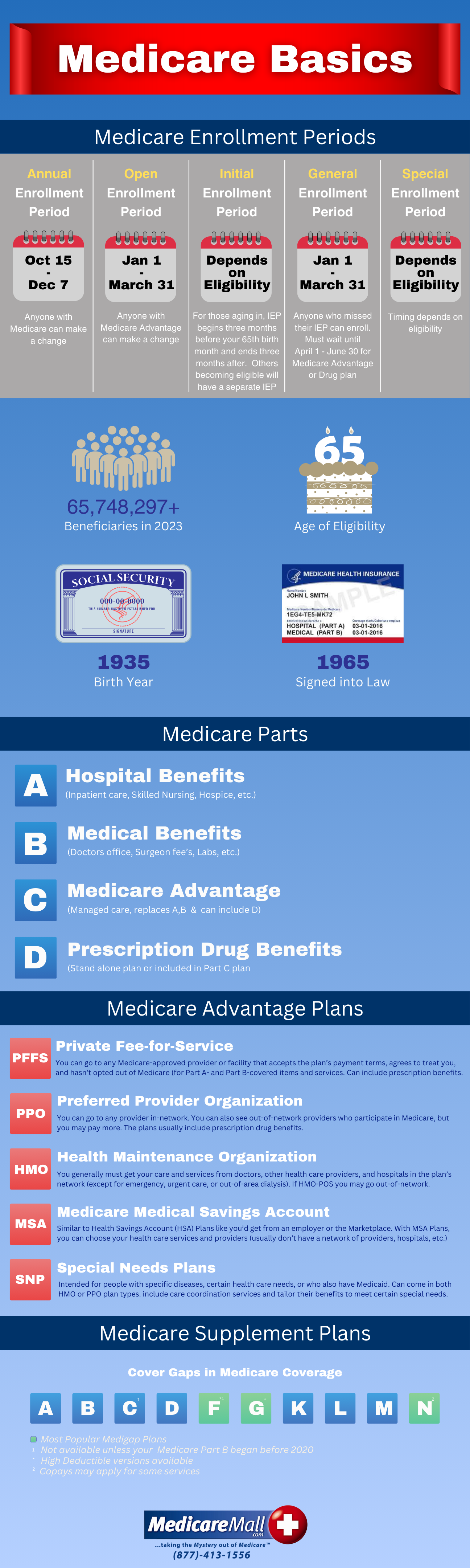
Your Initial Enrollment Period (IEP) is a 7-month window: it begins three months before the month you turn 65, includes your birthday month, and ends three months after. Enrolling early helps you avoid gaps in coverage and late penalties.
A quick quirk worth knowing: if your birthday falls on the 1st of the month, your coverage can start the month before you turn 65.
If you miss your IEP and don’t have other creditable coverage, you may have to wait for the General Enrollment Period (January 1 – March 31) and could face a lifelong late-enrollment penalty.
How to apply
You can apply for Medicare and Social Security benefits at ssa.gov. If you’re already receiving Social Security, enrollment in Parts A and B is usually automatic.
Key enrollment periods at a glance
- Initial Enrollment Period (IEP): The 7 months around your 65th birthday.
- General Enrollment Period: January 1 – March 31 (for those who missed their IEP).
- Open Enrollment (Annual Election Period): October 15 – December 7. Anyone with Medicare can change Part C and Part D coverage.
- Medicare Advantage Open Enrollment: January 1 – March 31. Those already in a Medicare Advantage plan can switch plans or return to Original Medicare.
- Special Enrollment Period (SEP): Triggered by qualifying life events, such as losing employer coverage. Timing depends on the event.
Medicare Part A: Hospital Insurance
Part A covers the care you receive as an admitted hospital patient and related services.
Covers:
- Inpatient Hospital Stays
- Skilled nursing facility care (following a qualifying hospital stay)
- Home health care
- Hospice care
2026 Costs:
- Premium: $0 for most people with 10+ years (40 quarters) of Medicare-covered work history. Those with fewer quarters pay up to $565/month.
- Hospital deductible: $1,736 per benefit period (not per year — a benefit period resets after 60 days out of inpatient care).
- Hospital coinsurance: $0 for days 1–60; $434/day for days 61–90; $868/day for lifetime reserve days.
- Skilled nursing coinsurance: $0 for days 1–20; $217/day for days 21–100.
Medicare Part B: Medical Insurance
Part B covers the day-to-day medical care you receive as an outpatient.
Covers:
- Doctor visits, outpatient care, lab tests, and preventive services
- Durable medical equipment
- Mental health and therapy services
- Telehealth and diagnostic testing
2026 Costs:
- Standard premium: $202.90/month (higher earners pay more based on income).
- Annual deductible: $283.
- Coinsurance: Medicare pays 80% of the approved amount for most covered services; you’re responsible for the remaining 20% unless you have supplemental coverage.
Medicare Part C: Medicare Advantage
Medicare Advantage (Part C) is an all-in-one alternative to Original Medicare. Offered by private companies approved by Medicare, these plans bundle your Part A and Part B coverage and often add extras like dental, vision, hearing, and prescription drugs (Part D).
Common plan types:
- HMO: Requires in-network doctors and referrals to see specialists.
- PPO: More flexibility to use out-of-network providers, usually at a higher cost.
- PFFS, HMO-POS, MSA, and SNPs: Specialized plan types designed for different needs and situations.
2026 Costs:
- You continue to pay your Part B premium, plus any premium the plan charges (many plans charge $0 beyond the Part B premium).
- Plans often have lower out-of-pocket costs than Original Medicare, but network and referral rules apply.
- Unlike Original Medicare, Medicare Advantage plans include an annual out-of-pocket maximum that caps your spending on covered services.
1965
Signed into law
~69.7 mil
Americans covered in 2025
Age 65+
Primary eligibility.
4 Parts
A, B, C, & D.
Understanding Medicare: A Complete Overview
Medicare can feel overwhelming, but it doesn’t have to be. Let’s break it down simply so you can make confident decisions about your healthcare.
A Brief History
Medicare was established in 1965 to provide healthcare coverage to Americans aged 65 and older. Today, it also covers younger individuals with disabilities and those with end-stage renal disease. The original program included Part A (hospital insurance) and Part B (medical insurance). Later, Parts C (Medicare Advantage) and D (prescription drug coverage) were added.
Get your FREE Medicare Supplement Quote Today
Medicare Enrollment Basics
Initial Enrollment Period
You’re eligible to enroll in Medicare starting three months before the month you turn 65, lasting until three months after. Enroll early to avoid delays. If your birthday is on the 1st, your coverage starts the month before you turn 65.
Applying for Medicare
You can apply for Medicare and Social Security benefits at ssa.gov. Enrollment is automatic if you’re already receiving Social Security.
Medicare Part A – Hospital Insurance
Covers:
Inpatient hospital stays
Skilled nursing facility care (post-hospital stay)
Home health care
Hospice care
Costs:
Premium: Free for most with 10+ years of work history
Deductible: Per benefit period (not annually)
Coinsurance: Applies after 60 hospital days
Medicare Part B – Medical Insurance
Covers:
Doctor visits, outpatient care, lab tests, preventive services
Durable medical equipment
Mental health and therapy services
Telehealth and diagnostic testing
Costs:
Monthly premium required
Annual deductible
Covers 80% of approved services (you’re responsible for the rest unless you have supplemental coverage)
Important: If you skip Part B when first eligible and don’t have other creditable coverage, you may face a late enrollment penalty.
Medicare Part C – Medicare Advantage
Medicare Advantage (Part C) is an all-in-one alternative to Original Medicare. Offered by private companies, these plans include Part A and B coverage, and often dental, vision, hearing, and prescription drugs.
Types of Plans:
HMO: Requires in-network doctors and referrals
PPO: More flexibility with out-of-network providers
PFFS, HMO-POS, MSA, SNPs: Specialized plan types for different needs
Costs & Access:
Fixed monthly Medicare payment to provider
Lower out-of-pocket costs, but network rules apply
Enrollment:
- Doctor visits, outpatient care, lab tests, preventive services
- Durable medical equipment
- Mental health and therapy services
- Telehealth and diagnostic testing
Costs:
- Monthly premium required
- Annual deductible
- Covers 80% of approved services (you’re responsible for the rest unless you have supplemental coverage) Important: If you skip Part B when first eligible and don’t have other creditable coverage, you may face a late enrollment penalty.
Medicare Part D – Prescription Drug Coverage
Covers:
Both brand-name and generic prescription medications
Standalone Plans or Included in Part C
Late enrollment penalties may apply if you don’t have creditable drug coverage
Includes phases such as initial coverage, coverage gap (donut hole), and catastrophic coverage
Compare Medicare Plans In Your Area Now
Medigap (Medicare Supplement Insurance)
Medigap plans help cover costs that Original Medicare doesn’t, such as deductibles, coinsurance, and copayments. There are 10 standardized plans: A, B, C, D, F, G, K, L, M, and N.
Popular Plans:
Plan G: Broad coverage except Part B deductible
Plan N: Lower premiums with some cost-sharing
Plan F: Only available to those eligible before 2020
Enrollment Tip: You have a guaranteed right to buy any Medigap policy within 6 months of enrolling in Part B if you’re 65 or older.

¹Plans F and G also have a high deductible option which require first paying a higher plan deductible before the plan begins to pay. Once the plan deductible is met, the plan begins to pay 100% of covered services for the remainder of the calendar year.. The annual deductible is determined by Medicare at the beginning of each year.
services for the rest of the calendar year. High deductible plan G does not cover the Medicare Part B deductible. However, high deductible plans F and G count your payment of the annual Medicare Part B deductible toward meeting the high plan deductible.
²Plans K and L pay 100% of covered services for the rest of the calendar year once you meet the out-of-pocket yearly limit.
Next Steps
Use our MedicareMall Quote Finder to compare plans and prices in your area. Our team is here to help guide you through your Medicare journey, ensuring peace of mind and long-term savings.
